Saturday, March 01, 2008

When Worse Than a Woman Who Voted was One Who Smoked

This funny little Wall Street Journal article about attitudes towards women smokers in the early 20th century. I normally would not post, but they reference the rules around smoking at Smith in the early 1900's... plus there are some choice quotes from a NY alderman. Enjoy!
"Several women's colleges banned smoking. At Smith College, students seen smoking, even off campus, received a demerit. Three demerits meant expulsion. Bryn Mawr students were prohibited from smoking within 25 miles of the college except in private homes."
If this had been the rule when we were at school, I think half my house would have been gone in the first week.

This quote has to be the best. Who knew that simply seeing a woman smoke could cause such havoc.
In 1922, a New York alderman, Peter McGuinness, proposed a city ordinance that would prohibit women from smoking in hotels, restaurants or other public places. "Young fellows go into our restaurants to find women folks sucking cigarettes," the alderman argued. "What happens? The young fellows lose all respect for the women, and the next thing you know the young fellows, vampired by these smoking women, desert their homes, their wives and children, rob their employers and even commit murder so that they can get money to lavish on these smoking women."

Labels: , ,

Wednesday, October 03, 2007

Sylvia Plath’s Youthful Art


Paintings and drawings by the poet Sylvia Plath, many never seen before, will be published in Britain this October by Oxford University Press to mark the 75th anniversary of her birth, The Guardian newspaper in England reported. The book “Eye Rhymes: Sylvia Plath’s Art of the Visual,” edited by Kathleen Connors and Sally Bayley, includes illustrated childhood letters, found in the Plath family attic in 1996, that Plath wrote when she was 7. There are also schoolbook sketches, portraits, photographs and paintings, including a self-portrait, that Plath made while an art student at Smith College. The works were all completed by the time she was 20, when she decided to concentrate on writing. Oxford plans to publish “Eye Rhymes” in the United States in January.

Guardian article: Revealed: Sylvia Plath's unseen art, discovered in the attic
The Book: Eye Rhymes: Sylvia Plath’s Art of the Visual

Labels: ,

Monday, September 03, 2007

1875 Ad for Smith College

I found this bit of Smith history in the archives. The ad ran in 1875 to encourage young women to apply. I have typed out the text below the image since its a little hard to read.


Smith College for Young Women
Northampton, Mass.
This college will be opened for the reception of students on the second Thursday, 1875. The course of studies occupying four years, will be fully equivalent to that in our best New England colleges for young men.
Candidates for admission to the lowest class will be examined in Arithmetic, Geography, the construction of the English language, general outlines of History, the Latin and Greek Grammars, the Catiline of Sallust, the seven orations of Cicero, the first six books of Virgil's Aenid, three books of Xenophon's Anabasis, two books of Homer's Iliad, Algebra to Quadratic Equations, and two books of Geometry.
For circulars or information apply to the President, Rev. L. Clark Seelye, Amherst Mass.; or to the Secretary of the Trustees, J.M. Greene, Lowell, Mass.

Labels:

Sunday, August 05, 2007

Smith Secret Societies

While looking for something completely different in the Smith archives I can across an entry about two secret societies that were once active on campus. I could only find any detailed information on one of the two groups mentioned, but thought it would be interesting to pass on.

From the Archives:
"Founded at Smith College in 1890, the Ancient Order of Hibernians (A.O.H.) was a secret society devoted to "the maintenance of devilish wit and the promotion of hellish spirit in the college." The group was intended to be a spoof upon "The Hibernians," a fraternal order of Irish Roman Catholics.

"A.O.H.'s patron saint was St. Patrick, its color was green, and its emblem was the shamrock. A.O.H enjoyed an intense rivalry with fellow secret society, the Orangemen, with whom they would compete for members." Membership was limited to twelve women from each class and members were inducted in the first semester of their first year. During the swearing in ceremony new members were given secret names and made to take the oath "I swear eternal hatred to the Orange and everlastin' loyalty to the Green, so help me St. Pat."

A.O.H was on of Smith's most popular secret societies until 1948 when President Davis abolished all secret societies on campus, calling them "undemocratic." At that time the group was forced to end all official activities, but records indicate that the group continued unofficially until the mid-1960s. All documentation ends with the 1965-1966 academic year.

Labels:

Sunday, May 27, 2007

Happy Memorial Day

In honor of Memorial Day I want to extend best wishes and support to our class members who are currently serving in military service or those who have family and loved ones serving. We support and wish you all health and safety in these tough times.

***

Also, in honor of memorial day I searched the college archives for a little Smith College military history. Smith was the site of a military officer training school during WWII. The first picture below was taken at Smith in 1943. Enjoy the short history from the college archives.


WAVES (Women Accepted for Voluntary Emergency Service


The United States entered WWII in 1941 and soon faced a serious shortage of manpower in the military. Congress, along with public interest and advocacy from various National organizations, forced the Department of the Navy (over considerable internal resistance) to start accepting women into their service to augment the many thousands of men already active in the war effort. On June 24, 1942, Congress passed an act to create a women's reserve as a branch of the Naval reserve; to be governed by the same rules and privileges and limited in that women could only work non-combat duty in the continental U.S. The idea was to free trained Naval men from desk jobs in order to increase the active fighting force--thus the rallying theme, "Free a man to fight." The new women's Naval Reserve units were called the WAVES (Women Accepted for Voluntary Emergency Services) and, with its sister Coast Guard Reserve the SPARS, proceeded to immediately set up training schools at many colleges and universities across the country. Basic training sites were located in Oklahoma (Oklahoma Agricultural and Mechanical College at Stillwater), Iowa (Iowa State Teacher's College at Cedar Falls), Wisconsin (University of Wisconsin at Madison), Indiana (University of Indiana at Bloomington), and New York state (Hunter College in New York City). Officer training sites were established in Massachusetts at Mt. Holyoke College in South Hadley, and at Smith College in Northampton.

The creation of the WAVES represented a fundamental change that was occurring in American society as the war effort increased. Women were moving from the home into the work force and gaining increasing independence. In WWI, 11,275 women served in the Navy, mainly in secretarial and office positions, but they were not recognized nor was their service publicized, and no formal program existed for their training. In 1942, for the first time women were in uniform, earning the same pay, doing the same work, following the same rules, and receiving the same respect as Navy men. The publicity surrounding the WAVES focused on their independence, intelligence and equality with their male counterparts. However, the naval officers took care to remind everyone of their gender when designing their uniforms. Pants were vetoed in favor of skirts, fitted jackets, and stack heeled shoes that served to emphasize the femininity of the recruits. Women came to the WAVES from all sections of society, bringing a wide variety of skills and experience. Originally, black women were banned from the WAVES, creating a great deal of friction at some of the training schools. The President lifted the ban in 1944 and later that year the first black female officers graduated from the Smith College training school.


By the end of the war over 83,000 women were serving in the Navy, a number significantly over the original estimate of 11,000. They filled positions such as parachute riggers, pharmacist's mates, instrument flying trainers, store keepers, radio dispatchers, clerks, mechanics, lab technicians, mail carriers, decoders, and navigators. Most of the officers were restricted to the rank of lieutenant with the notable exception of Captain Mildred McAfee (the president of Wellesley College) who was the director the WAVES. Soon after peace was declared in 1945, the WAVES and SPARS programs were dismantled and the women who had been in the Navy returned to their homes or civilian jobs.

Labels:

Thursday, April 12, 2007

Smith College: Home of the first Gym Suit

Everyday I get a news feed with various mentions of Smith College. Sometimes it interesting and sometimes its not and sometimes its not even about our Smith College... but this little mention made me smile and put google to work.

The Senior Journal's article Books for Seniors reviewed Patricia Campbell Warner's (professor of theater at the UMass Amherst) book When the Girls Came Out to Play. The book is a history of modern women's sportswear and how sportswear broke down traditional gender roles. Apparently Smith was home to a great evolution in women's gym wear... the Gym Suit...
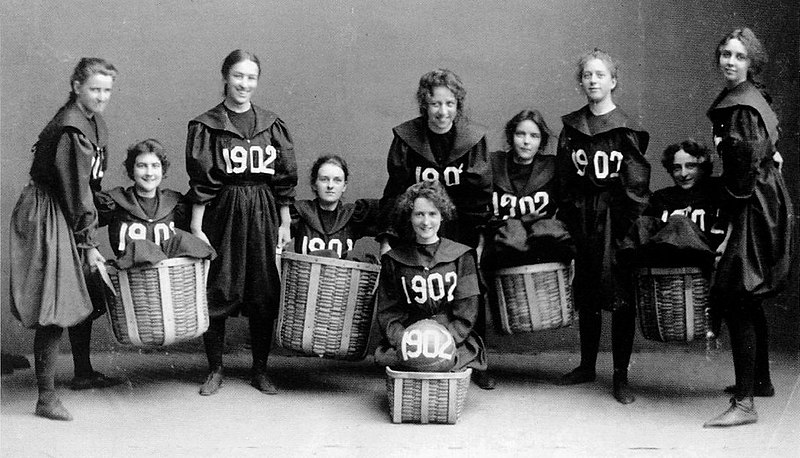
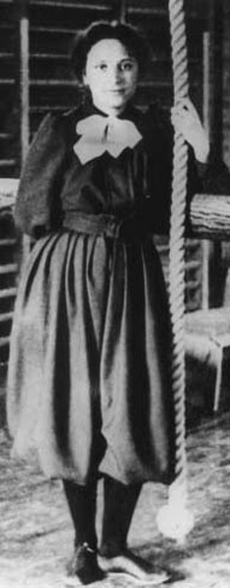
"the most enduring symbol of women’s athletic wear — the gym suit — was born in 1892 at Smith College when students took up the new game of basketball. Very quickly, it became apparent that skirts were too bulky and restrictive for the sport.

'From then on, comfort and common sense played an increasing role, finally overwhelming the conservatism and societal limitations that had kept women covered, compressed and in skirts,' says Warner."


Looking for some pictures for this post led me to information about Senda Berenson Abott, considered the "Mother of Women's Basketball". She was the Director of the Gymnasium and Instructor of Physical Culture at Smith and was the first person to introduce women's college basketball to Smith and the world. Shortly after joining Smith, Senda read about basketball and contacted the creator in Springfield, MA to find out more about the game. On March 21, 1893 she organized the first women's college basketball game at Smith. First years played sophomores in the Alumnae Gym, now home of the College Archives and Sophia Smith Collection.

Apparently she adapted the rules of the game to meet the "current thinking about women's physical limitations" and to make the game less "rough." Her rules were published seven years after that first game and were used for many years. She was also the editor of the first Women's Basketball Guide, a member and chair of the United States Women's Basketball Committee, and in 1985 was one of the first women elected into the Basketball Hall of Fame.

Labels: